Updated: March 31, 2026 By: Marios
Typically, enterprises do not rely on one technology platform. As a rule, most businesses use a combination of CRM software, ERP solutions, internal database systems, collaboration tools, and SaaS-based solutions. Therefore, in order for AI agents to be able to provide value at scale, the agents need to interact with each of those systems rather than requiring companies to build a new enterprise architecture.
As such, modern AI agent platforms are being developed around integration and orchestration. These platforms enable agents to draw data from many different systems, create automated processes, and trigger actions across enterprise technologies that already exist. Below are nine platforms that have demonstrated the ability to operate within an organization’s enterprise environment.
How AI Agent Platforms Integrate With Existing Enterprise Systems
AI agents are transforming enterprise operations by connecting with existing systems and automating workflows.
Key benefits include:
- Seamless integration: Works with CRMs, ERPs, databases, and cloud tools.
- Automated workflows: Reduce manual tasks and streamline processes.
- Scalable operations: Handles enterprise-level workloads efficiently.
- Secure data access: Maintains governance and compliance across systems
1. Lyzr AI

Lyzr AI: Enterprise Agent Infrastructure for Production-Ready AI
Lyzr AI is an enterprise-grade AI agent infrastructure platform built for organizations that need to move beyond experimentation and deploy autonomous, intelligent agents at scale. Designed for enterprises across banking, insurance, infrastructure, technology, and services, Lyzr enables teams to build, deploy, and manage AI agents across on-premise, cloud, and hybrid environments — without compromising on governance, security, or control. The platform is purpose-built for production: not just prototypes. At its core, Lyzr treats AI deployment as an infrastructure problem, not a tooling problem — giving enterprises the systematic architecture they need to operate AI agents reliably, safely, and at enterprise speed.
Key Capabilities
API-First Architecture:
Lyzr is built API-first, enabling seamless integration into existing enterprise systems, workflows, and data pipelines. Engineering and product teams can embed AI agent capabilities directly into their applications without rearchitecting core infrastructure.
Multi-Model Flexibility:
The platform supports deployment across leading large language models — including OpenAI, AWS Sagemaker-hosted models, and open-source alternatives — giving enterprises the flexibility to avoid vendor lock-in and choose models based on cost, compliance, or performance requirements.
Enterprise Integrations at Depth:
Lyzr connects natively with enterprise environments across AWS, internal knowledge bases, CRM systems, HR platforms, and document workflows. Agents operate within the data and systems teams already rely on — not in a separate, disconnected layer.
Built-In Governance and Safety Controls:
Every agent deployed through Lyzr is governed by configurable policy layers, guardrails, and compliance controls. Enterprises in regulated industries — banking, insurance, healthcare — can enforce rules around data access, output behavior, and audit logging without custom engineering effort.
Multi-Agent Orchestration:
Lyzr supports coordinated multi-agent workflows where specialized agents collaborate, delegate tasks, and hand off context. This enables complex enterprise processes — from loan origination to customer onboarding to procurement — to be handled end-to-end, not just at individual touchpoints.
Private and Secure Deployment:
Enterprises can deploy Lyzr within their own cloud infrastructure or on-premise environments, ensuring sensitive data never leaves the organizational boundary. This is critical for BFSI, healthcare, and government use cases where data residency is non-negotiable.
Pre-Built Agent Blueprints:
Lyzr provides a library of production-ready agent blueprints across banking, HR, sales, insurance, procurement, and marketing — reducing time-to-value significantly. Teams do not need to build from scratch; they configure, customize, and deploy.
Simulation and Evaluation Engine:
Before going live, agents can be tested through Lyzr’s simulation engine with multi-turn evaluation scenarios. This allows enterprises to validate agent behavior, stress-test edge cases, and build internal confidence before production release.
Scalable Infrastructure for Enterprise Workloads:
Lyzr is designed to scale — handling high-volume, concurrent agent interactions across business functions. Whether supporting a single team or a cross-functional enterprise rollout, the platform maintains performance, reliability, and operational consistency.
2. MindsDB

MindsDB enables AI agents to access data in its native location within the enterprise, rather than moving data to a separate AI platform. This means that instead of creating a new platform that requires data to be moved out of existing databases and applications, MindsDB simply connects the AI agents to the existing infrastructure.
This enables organizations to use AI by utilizing their existing data architecture.
Key Capabilities
- Database connectivity: Connecting to enterprise databases, SaaS, etc., as well as data warehouses.
- AI Data Querying: Allowing AI Agents to query both structured and unstructured data natively.
- Predictive Modeling: Supporting Machine Learning Models for forecasting and Analytics.
- Data Efficiency: Allowing Organizations to reduce the amount of data they have to move or pipeline.
MindsDB provides an effective way for Enterprises to utilize AI without having to move or duplicate data when working with multiple and distributed data source locations.
3. Salesforce Agentforce

Agentforce is developed for businesses that are currently utilizing the Salesforce Ecosystem. Agents will be able to connect with CRM information through the use of AI, create workflow automation for customers, and help sales and customer support teams.
Key Capabilities
- Salesforce Integration: Integrates with all aspects of the Salesforce CRM and Ecosystem Products.
- Workflow Automation: Creates automated workflows for Sales, Marketing, and Customer Support functions.
- Access to Customer Data/Analytics: Provides agents with access to CRM data and analytics.
- Reporting: Tracks and monitors agent performance through built-in reporting features.
Salesforce Agentforce is perfect for businesses that are fully embedded in the Salesforce Ecosystem. With Agentforce, agents are able to automatically create workflows and have seamless access to CRM data to increase efficiency in sales and customer support.
4. LangChain
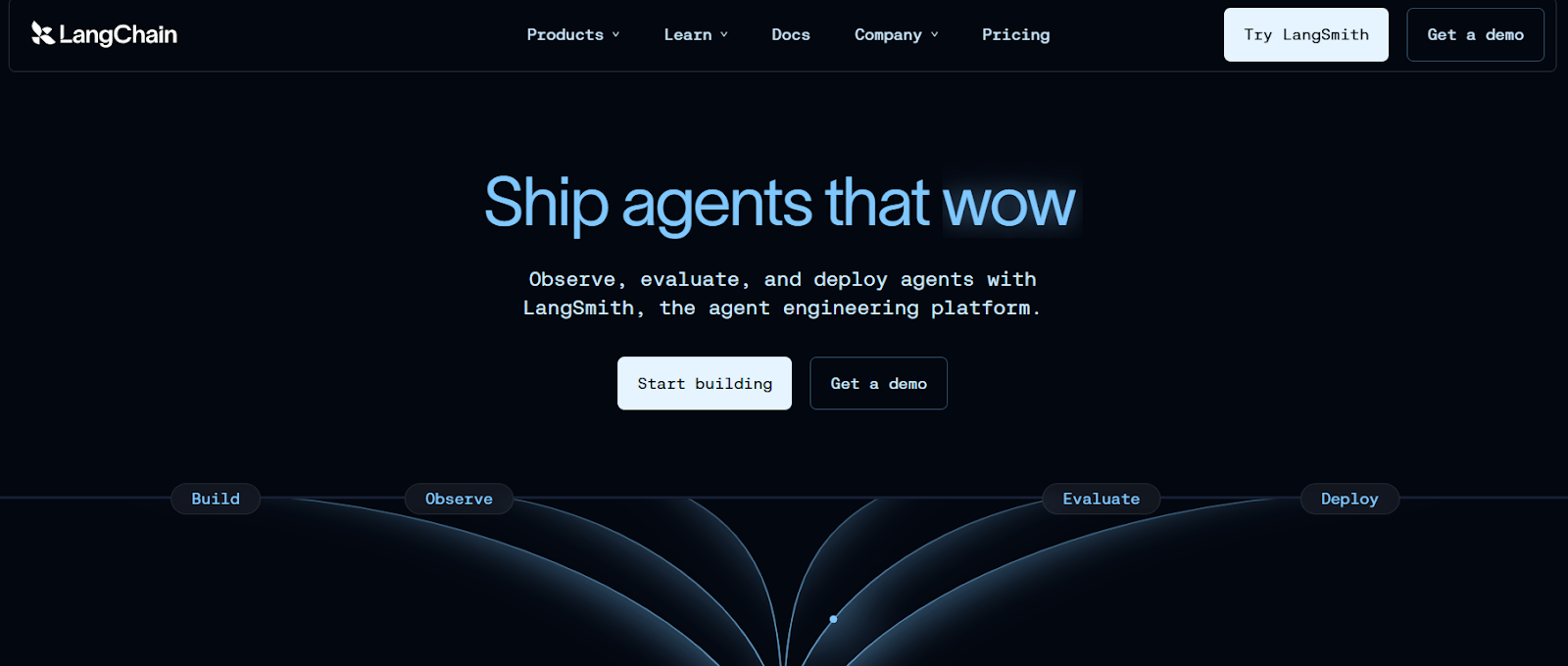
LangChain is a popular developer tool for building AI agents to interact with APIs, databases, enterprise systems, and so on. It is a flexible framework for building multi-step workflows that can be composed of various AI models and external services.
Key Capabilities
- API integrations: Connects AI agents with external tools and enterprise systems.
- Workflow chaining: Supports multi-step and multi-agent processes.
- Model compatibility: Works with multiple LLM providers.
- Custom development: Allows developers to build highly tailored workflows.
LangChain is a flexible framework for creating custom AI agents and workflows. It is particularly suitable for developers building multi-step processes that span multiple tools or systems.
5. Microsoft Copilot Studio

Microsoft Copilot Studio lets companies develop and deploy AI agents in their Microsoft environments.
Key Capabilities
- Microsoft Ecosystem Integration: Built-in support for Microsoft 365, Dynamics, and Azure Services.
- Low-Code Development: Provides a platform to rapidly develop and implement AI Agents with minimal programming skills required.
- Automation of Workflows: Creates connections between Microsoft Productivity Applications.
- Low-Code Development: Provides a platform to rapidly develop and implement AI Agents with minimal programming skills required.
- Automation of Workflows: Creates connections between Microsoft Productivity Applications.
Microsoft Copilot Studio lets companies develop and deploy AI agents in their Microsoft environments.
6. Google Vertex AI Agent Builder
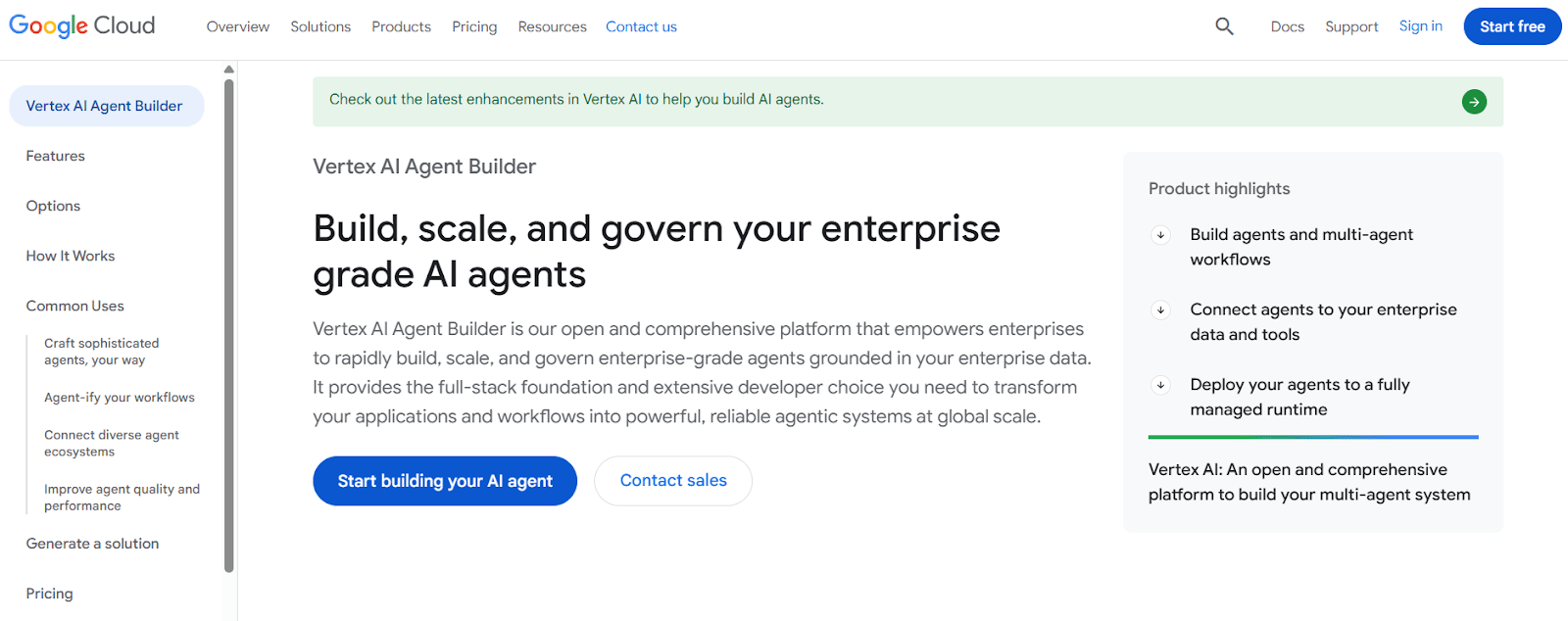
Enterprises can build their own conversation agents and automate business workflows utilizing Google Cloud’s infrastructure via Vertex AI Agent Builder. Additionally, it can be integrated into the organization’s data sources and APIs.
Key Capabilities
- Cloud Integration: Works with Google Cloud and its services as well as enterprise APIs.
- Conversational Agents: Allows users to create both chat-based and search-based AI Agents.
- Data Connectivity: Can integrate with an enterprise data platform and/or enterprise analytics tools.
- Deployed Scalability: Built to support large-scale workloads within enterprises.
Using Vertex AI Agent Builder will allow you to deploy your AI Agents in the cloud and provide scalability. This product also has the advantage of being able to connect to your data sources and APIs provided by Google Cloud, which makes it a good option for data-driven companies.
7. Amazon Bedrock Agents
Organizations may use Amazon Bedrock Agents to develop AI agents to interact with both AWS services and other external systems.
Key Capabilities
- Integration with AWS: Utilizes AWS-based enterprise services and infrastructure.
- Flexibility in model support: Will support a wide variety of foundation models.
- Security in data access: Enables controlled access to enterprise-based data sources.
- Automated workflow processing: Provides an automated method of executing cloud-based business process workflows.
Amazon Bedrock Agents are suited for AWS-centric enterprises. Amazon Bedrock Agents provide a straightforward deployment solution by allowing for secure data access and workflow automation within cloud-based workflows.
8. ServiceNow AI Agent Orchestrator
The primary focus of ServiceNow’s AI Agent Orchestrator is automating enterprise service process work, such as IT operations, HR workflows, and other business processes for internal support functions.
Key Capabilities
- Workflow Automation: Workflow automation of IT, HR, and Enterprise Services Processes.
- Integration with Platform: Works in conjunction with the ServiceNow Enterprise Platform.
- Coordination Between Agents: Multi-Agent Coordination allows multiple agents to work together on a single workflow or task.
- Governance: Includes tools to ensure compliance and monitor performance.
The AI Agent Orchestrator in ServiceNow offers organizations automated enterprise service/IT workflows and also provides a method to coordinate agents across an organization to help streamline the operational workflow.
9. OpenAI Agents SDK
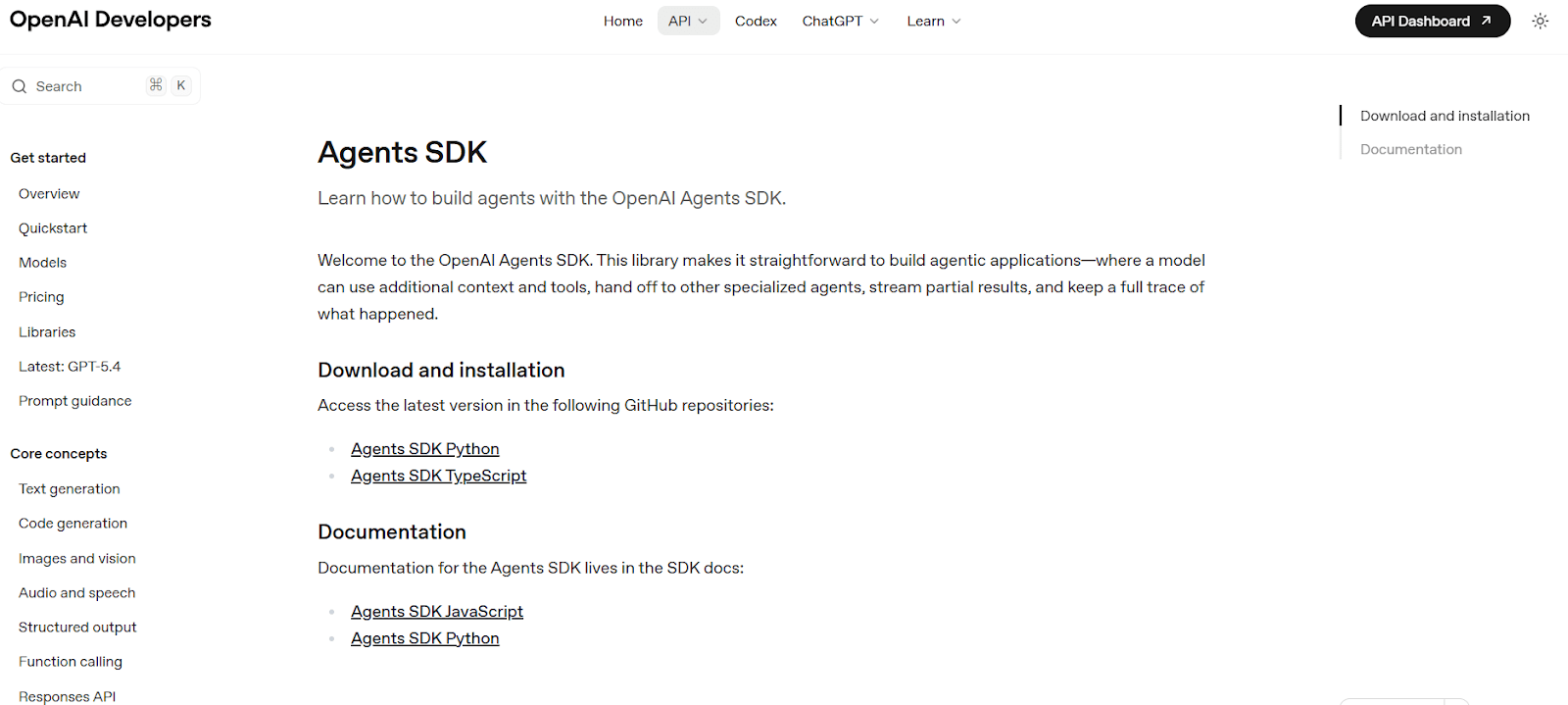
With the OpenAI Agents SDK, internal engineering teams have the ability to build and deploy custom AI agents in relation to how their companies use systems. Through the agents, developers are able to connect with the company’s API’s, database, and other enterprise tools.
Key Capabilities
- Enterprise API integration: Connects directly to an organization’s enterprise API and business tools.
- Developer-defined agent logic: Provides engineers the ability to customize and define their own workflows.
- Agent interaction with outside tools: Allows agents to interact with outside systems.
- Enterprise scalable architecture: Scalable enough to be deployed within large-scale enterprises.
The OpenAI Agents SDK gives organizations the most possible flexibility when building completely customized AI agents. It will also provide internal engineering teams with complete control of their integrations and workflow.
Final Thoughts
Enterprise work processes are being dramatically changed by AI agents that interact seamlessly with current business systems. They also automate many of the tasks a worker performs and allow for decisions based on real-time, actionable intelligence.
Using flexible methods to connect, safe ways to handle sensitive information, and scalable forms of automation enable organizations to increase productivity without having to replace the infrastructure they have in place.
Ready to make your organization’s workflow process more efficient and to use AI across all of your enterprise? Find out now how smart agents will change the way you do business.


