Factory.ai is an advanced agent-native development platform designed to transform how software teams build, maintain, and scale applications. It introduces a new paradigm for engineering productivity by embedding AI-powered “Droids” directly into a developer’s workflow—whether that’s in the IDE, command line, web interface, or communication tools like Slack and Teams.
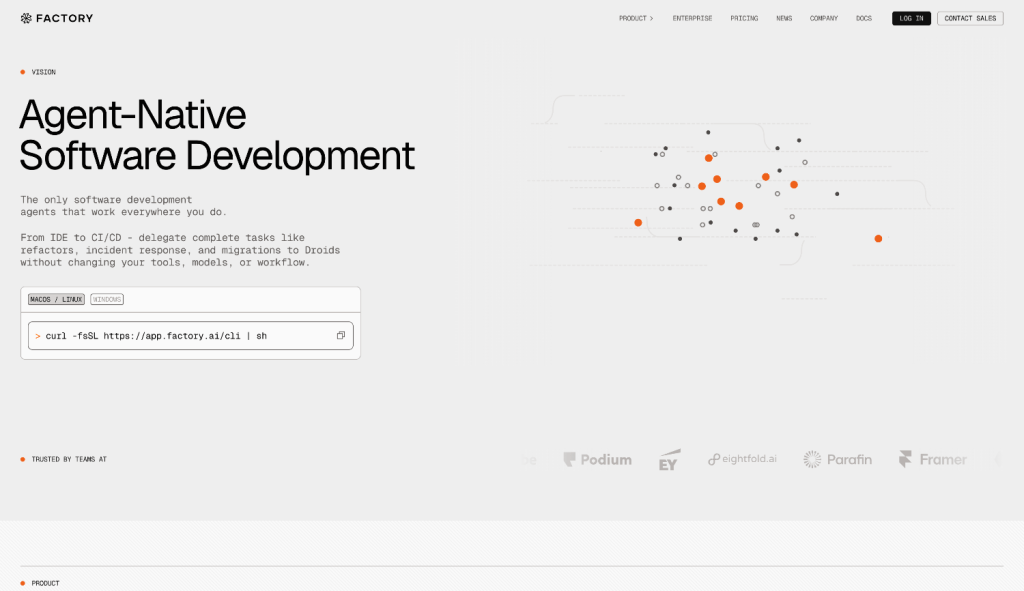
These Droids act as intelligent engineering assistants capable of performing a wide range of development and operational tasks autonomously, from code refactoring and debugging to infrastructure automation, migrations, and incident management.
Rather than forcing developers to switch tools or learn new environments, Factory.ai integrates seamlessly into existing systems and processes.
It treats AI agents as native extensions of a company’s development ecosystem—empowering teams to delegate repetitive, error-prone, or large-scale engineering work to reliable AI agents while maintaining full control and visibility. This approach enables faster delivery cycles, higher code quality, and reduced operational overhead.
Factory.ai’s philosophy revolves around augmenting developers, not replacing them. It’s built to scale across teams and organizations of all sizes—offering enterprise-grade security, flexible integration with various model providers, and compatibility with the most popular development environments.
The platform is both vendor-agnostic and interface-agnostic, allowing companies to plug in their preferred AI models while ensuring that workflows remain efficient, auditable, and secure.
Key Features of Factory.ai
1. Agent-Native Engineering Automation
Factory.ai’s “Droids” operate as intelligent software agents that can take on tasks like refactoring, reviewing, or deploying code, integrating directly with development pipelines to automate complex operations.
2. Seamless Multi-Platform Integration
Developers can access and control Factory.ai’s agents through IDEs like VS Code or JetBrains, the command line, or web dashboards. The system also connects with collaboration tools such as Slack and Microsoft Teams for real-time coordination.
3. Scalable Multi-Agent Workflows
The platform supports orchestrating multiple agents in parallel—ideal for handling large-scale tasks like bulk code migrations, CI/CD automation, or system upgrades across entire repositories.
4. Enterprise-Grade Security and Compliance
Built for enterprise environments, Factory.ai includes strict security measures, role-based access, encrypted data handling, and compliance options for regulated industries.
5. Model-Agnostic Architecture
Factory.ai works with any large language model provider, giving organizations flexibility to use their own models, open-source alternatives, or proprietary AI systems.
6. End-to-End Developer Visibility
Every action taken by a Droid is transparent and traceable, ensuring developers maintain oversight and can review or revert changes as needed.
7. Intelligent Context Awareness
Factory.ai’s Droids understand context across codebases, documentation, and project structure, allowing them to make high-quality suggestions and perform actions with minimal input.
8. Workflow and Pipeline Integration
The platform integrates deeply with CI/CD systems, allowing automated code reviews, testing, and deployments without disrupting established processes.
9. Team Collaboration and Communication
By integrating with communication platforms, Factory.ai allows team members to assign, monitor, and interact with Droids directly in their chat tools—turning everyday collaboration into an AI-augmented workflow.
10. Designed for Reliability and Scale
Factory.ai emphasizes robust infrastructure, capable of supporting large enterprise teams running thousands of tasks simultaneously, with high uptime and consistent performance.
In essence, Factory.ai represents a next-generation evolution in developer tooling—where AI agents become embedded team members that enhance productivity, automate complexity, and enable software engineering at a scale and speed that traditional tools cannot match.


